


Have you ever sat in a church pew, or maybe just read a book, and found yourself completely puzzled by the concept of the Trinity? Honestly, I’ve been there too. 😊 It’s one of those ideas that sounds so simple on the surface—Father, Son, and Holy Spirit—but the moment you try to explain it, your brain starts doing gymnastics. How can three be one, and one be three? Is it some sort of divine math problem?
What Exactly is the Trinity? 🤔
To put it simply, the doctrine of the Trinity states that there is only one God, but this one God exists eternally as three distinct persons: the Father, the Son (Jesus Christ), and the Holy Spirit. I know what you’re thinking—that still sounds a bit contradictory, right? Well, the key is understanding the difference between \”being\” and \”person.\”
In theological terms, Being (or essence) is what you are, while Person is who you are. God is one in essence, but three in persons. They aren’t three different gods, nor are they just three \”masks\” that one God wears. They are entirely distinct yet entirely united in purpose, will, and divine nature.
Whenever you get confused, remember this simple formula from historic Christianity: God is ONE in \”What\” and THREE in \”Who.\”
Historical Roots 🏛️
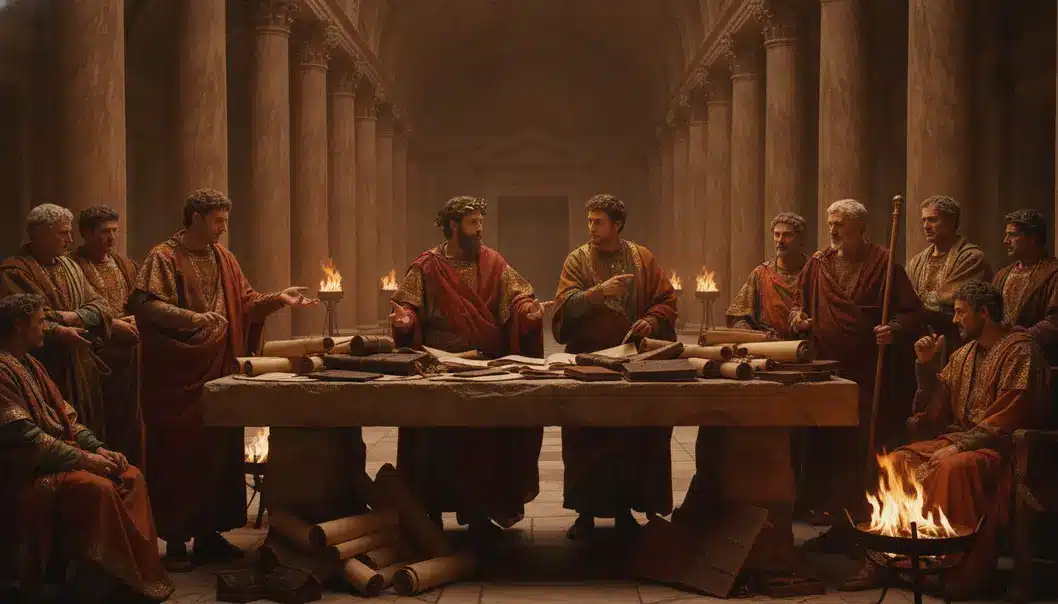
The word \”Trinity\” actually isn’t in the Bible. Surprising, isn’t it? The concept, however, is woven throughout the biblical texts. It took a few hundred years for early Christians to formally define it, primarily to defend their beliefs against misunderstandings and emerging debates about the nature of Jesus.
| Historical Event | Year | Key Outcome |
|---|---|---|
| Council of Nicaea | 325 AD | Affirmed the Son is of the exact same essence as the Father. |
| Council of Constantinople | 381 AD | Affirmed the deity of the Holy Spirit, completing the core Trinitarian dogma. |
The Trap of Analogies 🧮
We humans love analogies. We try to explain the Trinity using things like an egg (yolk, white, shell) or water (ice, liquid, steam). But here’s the catch—almost every physical analogy eventually breaks down and leads to what early church leaders called \”heresies\” (incorrect teachings).
Using the \”water, ice, steam\” analogy actually describes a concept called Modalism, which suggests God just changes forms or masks, rather than existing as three distinct, co-eternal persons!
🔍 Analogy Checker
Select a common analogy to see where it falls short:

📝 Summary & Key Takeaways
We’ve covered a lot of ground today! From deep theological concepts to church history and broken analogies, the Trinity remains a beautiful mystery at the heart of the Christian faith. Let’s recap the most important points.
The Trinity Summarized
FAQ ❓
I truly hope this deep dive into the Trinity helped clear up some of the fog! It’s a vast, deeply beautiful, and sometimes overwhelming topic. If you have any more questions, or if you just want to share your own thoughts on how you view it, feel free to drop a comment below! I’d love to hear from you. 😊