
Have you ever been in a quiet library or an important meeting, only for your laptop to suddenly sound like a jet engine taking off? 😅 I’ve definitely been there, frantically trying to muffle my computer as it desperately tried to cool itself down. We’ve all accepted this noisy, dusty reality as a necessary evil of modern technology. But what if I told you there’s a completely silent, fanless solution that’s actually more powerful? That’s exactly what AirJet technology is all about, and honestly, it feels like pure magic.
What is AirJet? 🤔
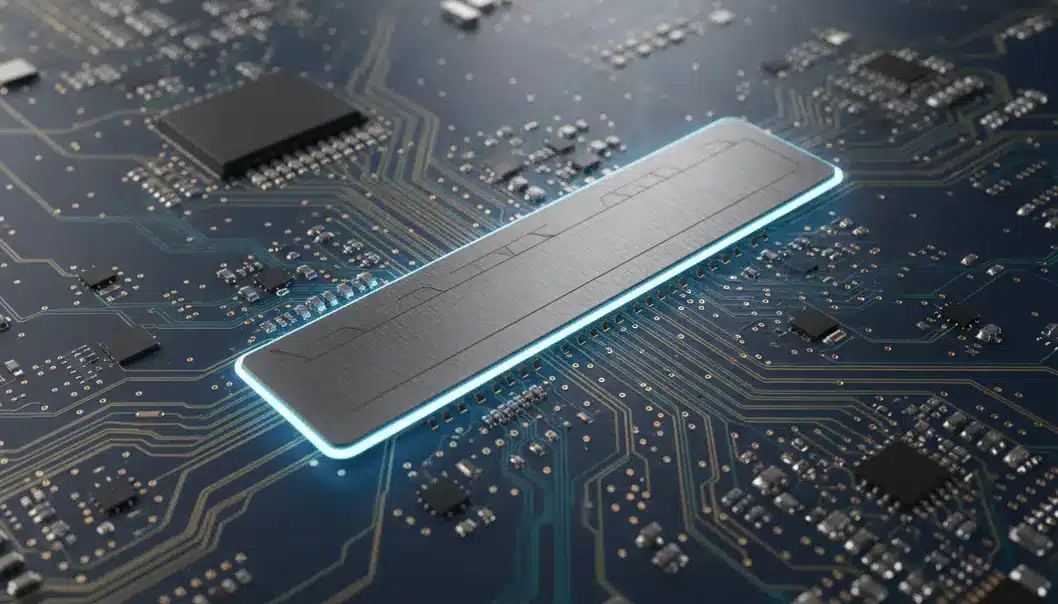
Developed by Frore Systems, AirJet is the world’s first solid-state active cooling chip for electronic devices. To put it simply, it replaces the traditional, bulky mechanical fans we’ve been using for decades with a tiny, vibrating chip that moves air without any rotating blades.
Instead of a fan spinning and pushing air, AirJet uses incredibly tiny membranes that vibrate at ultrasonic frequencies. These vibrations generate a massive pressure wave that pulls cool air in through top vents and blasts hot air out the sides. It’s an entirely new paradigm for thermal management in gadgets.
Solid-state cooling means there are no spinning parts to break down over time. It’s fundamentally more durable and less prone to dust accumulation than traditional fans!
How Does Solid-State Cooling Work? 🌬️
I remember first reading about this and thinking, “Wait, how can a flat piece of silicon blow air?” The secret lies in piezoelectric materials. When an electrical current is applied, these materials change shape. By rapidly turning the current on and off, the membranes inside the AirJet chip flutter at lightning speed.
This fluttering creates a powerful suction effect. The pressure generated is actually up to 10 times higher than a conventional fan, which means it can push air through much tighter spaces. This allows manufacturers to build even thinner laptops and handheld gaming consoles without sacrificing performance.
While AirJet is incredibly efficient, it cannot be simply retrofitted into your current laptop. Devices must be specifically designed and engineered from the ground up to integrate these chips.
AirJet vs. Traditional Fans 📊
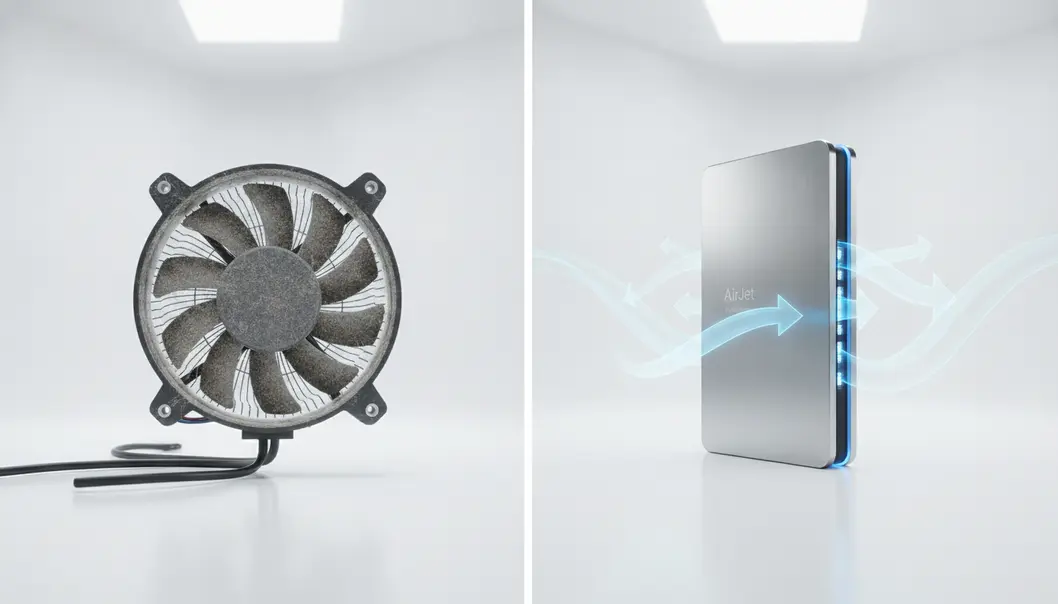
To truly appreciate this innovation, we need to compare it to the old guard. When I looked at the actual numbers, I was genuinely shocked by the difference in thickness and pressure.
| Feature | AirJet Mini | Traditional Laptop Fan |
|---|---|---|
| Thickness | 2.8 mm | ~5.0 mm to 10.0 mm |
| Back Pressure | 1,750 Pascals | ~140 Pascals |
| Noise Level | 21 dBA (Practically silent) | 40+ dBA (Audible whir) |
| Heat Removal | 5.25 Watts per chip | Varies (requires bulky heatsinks) |
Calculate Your Cooling Needs 🧮
Since AirJet chips are modular, manufacturers simply add more chips to dissipate more heat. For example, an ultra-thin tablet might only need one AirJet Mini, while a high-performance 15-inch laptop might use three or four AirJet Pros.
🔢 AirJet Capacity Calculator
Curious how many chips a device needs? Enter the target heat dissipation (in Watts) to see!
📝 Real-World Example: Handheld Gaming
Consider devices like the Steam Deck or ROG Ally. Gamers often complain about thermal throttling—when the device gets too hot, it intentionally slows itself down to prevent melting.
- Current State: Rely on bulky fans that draw heavy battery power and make a whining noise.
- AirJet State: Manufacturers can slot in 3 AirJet Minis. The device stays cool, gaming performance doesn't drop (no thermal throttling!), and it remains nearly silent.
AirJet Technology Summary
FAQ ❓
In conclusion, the era of noisy, overheating electronics is finally coming to an end. Solid-state active cooling isn't just an incremental update; it's a monumental leap forward for how we design and use technology. I, for one, am incredibly excited for a future where my laptop doesn't sound like it's preparing for takeoff during my work sessions!
What are your thoughts on this new technology? Are you excited to get your hands on an AirJet-cooled device? Let me know in the comments below, and feel free to ask any further questions you might have! 😊