

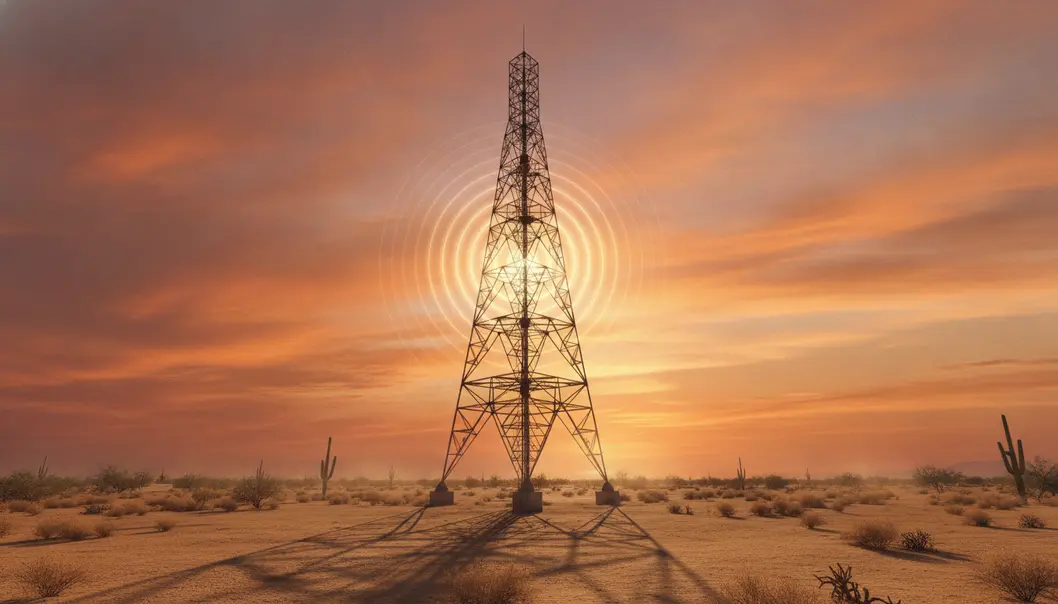
Have you ever been on a long, dark road trip late at night, scanning the AM radio dial, and suddenly caught a faint but wildly energetic voice fading in and out of the static? I can still remember the thrill of catching distant stations as a kid. It felt like magic. But back in the 1960s, there was one station you didn’t have to strain to hear. In fact, it was so powerful it could practically rattle your teeth from a thousand miles away. I’m talking about the legendary XERF. 😊
Today, we’re diving deep into the fascinating story of XERF-AM, the Mexican “border blaster” that defied US regulations, blasted rock and roll across North America, and gave birth to the mythos of Wolfman Jack. To be honest, the story of how this station operated is almost as wild as the music it played!
The Birth of the Border Blasters 📻
To truly understand XERF, we have to look at why it existed in the first place. In the early days of radio, the US Federal Communications Commission (FCC) strictly limited AM radio stations to a maximum broadcasting power of 50,000 watts. This was a sensible rule designed to prevent stations from interfering with each other across the country.
But what if you wanted to reach the entire continent and didn’t want to play by the FCC’s rules? Well, you simply crossed the border! Enter the Border Blasters. By setting up massive transmitters just south of the US-Mexico border, broadcasters were subject to Mexican regulations—or rather, the lack thereof. Mexico happily licensed stations at 100,000, 250,000, and even 500,000 watts!
At its peak, XERF operated at an astonishing 250,000 watts. Local legends claim that the signal was so powerful, people in the nearby town of Del Rio, Texas, could actually hear the broadcasts through their barbed wire fences and even their dental fillings!
Comparing the Powerhouses 📊
Just how big was XERF compared to a standard American station? Let’s take a look at the numbers. It’s honestly mind-boggling when you put it side-by-side with what was legally allowed in the United States at the time. I think seeing the sheer difference in wattage explains exactly why XERF became such a cultural phenomenon.
| Station Type | Max Power (Watts) | Location | Primary Audience |
|---|---|---|---|
| Local AM (US) | 250 – 1,000 W | Any US City | Single Town/County |
| Clear Channel AM (US) | 50,000 W | Major US Hubs | Multi-State (Nighttime) |
| Border Blaster (XERF) | 250,000 W | Ciudad Acuña, Mexico | Entire North America |
With that massive 250 kW transmitter, XERF at 1570 kHz could blanket the entire North American continent once the sun went down. This immense reach perfectly set the stage for the incredibly colorful characters who would buy airtime on the station. Let’s move on to the most famous of them all in the next section!

Enter the Wolfman 🐺🎤
You simply can’t talk about XERF without mentioning its most famous personality: Bob Smith, better known to the world as Wolfman Jack. In the early 1960s, the Wolfman took over the nighttime slot at XERF. With his raspy, howling delivery and his incredible taste in rhythm and blues, soul, and rock ‘n’ roll, he created a mysterious persona that teenagers across America obsessed over.
Because the station was unregulated by the FCC, Wolfman Jack could play absolutely whatever he wanted. He introduced white teenage America to black R&B artists that conservative US stations flat-out refused to play. It was rebellious, it was raw, and it was entirely mesmerizing.
📝 The Wild World of Mail-Order Goods
Since border blasters survived by selling airtime to literally anyone who could pay, the commercials were just as entertaining (and bizarre) as the music. Advertisers sold the craziest things to the massive nighttime audience:
- \”Autographed\” pictures of Jesus Christ
- 100 live baby chicks for just a few dollars
- Miracle tonics and questionable weight-loss pills
- Glow-in-the-dark religious statues
Needless to say, most of these mail-order products were absolute scams. The \”live baby chicks\” often arrived at the post office completely frozen or worse. Consumer protection wasn’t exactly a priority in the border blaster era!
The Science of the Signal: Skywave Propagation 🌌
How did XERF reach all the way from Mexico to Canada? It all comes down to the fascinating physics of radio waves. During the day, AM radio waves travel mostly along the ground (known as groundwave) and are gradually absorbed by the earth. But at night, a layer of the Earth’s atmosphere called the ionosphere changes its properties. It acts like a giant mirror for AM frequencies.
This phenomenon is called Skywave Propagation or \”skip.\” The massive 250,000-watt signal of XERF would shoot up into the night sky, bounce off the ionosphere, and land thousands of miles away, completely bypassing local stations. Let’s try a fun little calculator I put together to visualize how wattage affects daytime versus nighttime reach!
🔢 AM Radio Range Estimator
Enter a transmitter power (in Watts) to estimate its rough daytime and nighttime coverage area.
📝 Summary & Legacy
The golden age of XERF eventually faded as FM radio took over, offering much higher fidelity and stereo sound. Additionally, both US and Mexican governments began cooperating to regulate the airwaves more strictly. But for a brief, glorious period, XERF was the undisputed king of the night.
XERF Fast Facts
FAQ ❓
I really hope you enjoyed this dive into the wild west of early radio! Have you or your parents ever talked about tuning into distant AM stations late at night? Did you ever hear the Wolfman howl through the static? Let me know in the comments below—I'd absolutely love to hear your stories! 😊